
Our approach
Creating Shared Value

To achieve a resilient business and support the growing global population, we need to support the transition to regenerative food systems at scale.
The global food system is at a critical juncture. The effects of a warming planet, the resulting nature and biodiversity loss and extreme weather events are more and more evident. Climate change is speeding up the depletion of natural resources and damaging the natural ecosystems we rely on to produce food.
We play our part in addressing these challenges through key initiatives – our Net Zero Roadmap (pdf, 25Mb), The Nestlé Agriculture Framework (pdf, 18Mb), and our Human Rights Framework and Roadmap (pdf, 11Mb) – that support our continuous growth, while ensuring we can serve future generations of consumers.
We collaborate closely with farmers, suppliers and partners to help create a more resilient food supply – one that aims to benefit all actors in our supply chain, as well the growth of our business. This is a critical part of Creating Shared Value, our strong conviction that a company should create value both for its shareholders and society at large.
Our Regeneration Wheel – How we create Shared Value
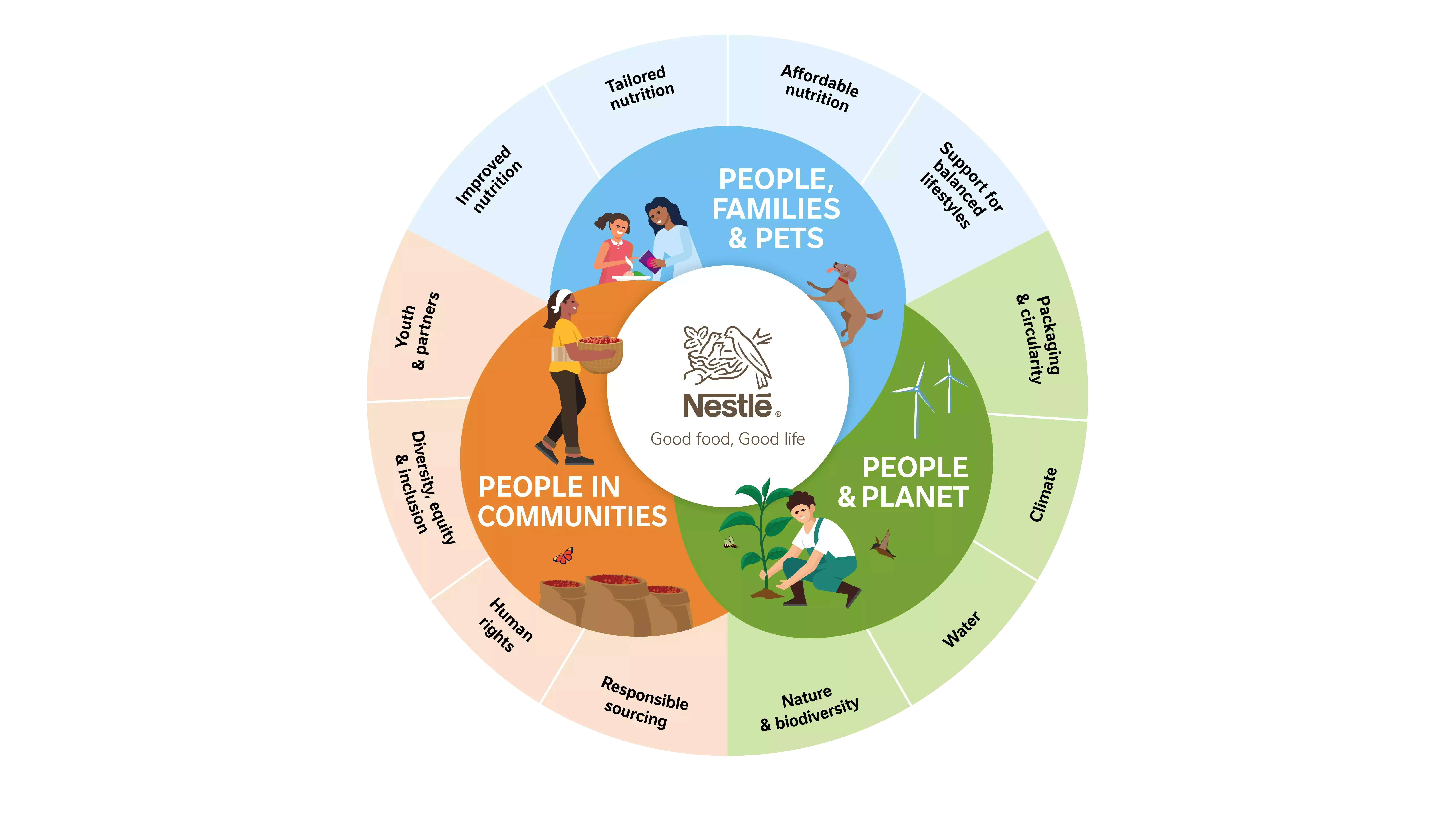
The challenges we face – a warming planet, nature and biodiversity loss, extreme weather events, depletion of raw materials, economic inequality – are all closely linked. Our efforts to address these challenges are holistic.
We use what we call our regeneration wheel to show how the different areas where we work on Creating Shared Value are interconnected. It reflects our aim to deliver value for people and pets, communities and the planet while ensuring our long-term business success.

Transforming agriculture for a resilient future
Regenerative agriculture, by design, aims to improve soil health, biodiversity and water resources. It promotes the adoption of practices such as the reduction of synthetic inputs, agroforestry, cover crops, reduced tillage, riparian buffers, integrated pest management and integrated soil fertilization management.
We understand that shifting from traditional practices to new ways of farming can be difficult, which is why we follow a holistic approach that includes finance and incentives, training, and creating market demand for ingredients grown on farms that have adopted regenerative agricultural practices.
By 2030, we aim to source 50% of key ingredients from farmers adopting regenerative agriculture practices.

Supporting a just transition
Our aim is to improve the livelihoods of farming communities across the world, allowing them to support themselves and their families. The path to regenerative agriculture is long. This is why we are helping farmers by providing financial support, remunerating good practices and offering technical and scientific guidance, through programs like the Nescafé Plan, Nespresso AAA Sustainable Quality TM Program and income accelerator program. This approach, along with the respect and promotion of human rights, is designed to contribute to a just transition to new practices throughout our supply chains.
Nature and biodiversity
We are working to help safeguard natural resources, in particular forests and natural ecosystems, which provide habitats for many species, store water, absorb carbon dioxide, and contribute directly to the livelihoods of Indigenous peoples’ and local communities, which support much of the planet’s biodiversity. We do this through landscape initiatives, as well as initiatives dedicated to water stewardship, and by sourcing ingredients that are assessed deforestation-free.
For example, our Global Reforestation Program is undertaking large-scale reforestation projects in our supply chains and sourcing landscapes with projects in Brazil, Colombia, Côte d’Ivoire, Mexico, Vietnam, Australia, China, Honduras, Nicaragua, and Thailand.
We continue to make significant progress toward our aim that our primary supply chains for meat, palm oil, pulp and paper, soy, sugar, cocoa and coffee are assessed deforestation free. In 2024, 93.5% of our primary supply chains were assessed as deforestation-free.
Further details can be found in our Non-Financial Statement 2024 (pdf, 5.6Mb).
Addressing climate change
Our business relies on nature for the supply of raw ingredients to make our products. Therefore, our supply chains must be resilient against the negative impacts of climate change on food-system productivity and on the well-being of farmers, producers and their communities.
We believe addressing climate change is a business imperative. Guided by our Net Zero Roadmap, we aim to reduce our GHG emissions by 50% by 2030 and are committed to reaching net zero by 2050. We are proud of the progress made so far. We have transitioned to sourcing 100% sourced renewable electricity in all manufacturing sites as we strive to reduce our reliance on fossil fuels. We are also integrating nature-based solutions – for example, by aiming to source 50% of key ingredients from farmers adopting regenerative agricultural practices by 2030.
Advancing regenerative food systems at scale
Our ambition is to advance regenerative food systems at scale. Each word in this phrase is important and addresses how we are accelerating our activities:
- Advance by raising our voice and using our influence to drive progress, in collaboration with others
- Regenerative to help protect, renew and restore farmland and landscapes
- Food systems encompassing every actor, activity, process and product involved in growing, raising, making, delivering and consuming food and the management of food and food-related waste
- At scale because the planet, communities and individuals need global, systems-level change
We work with suppliers and partners to pursue this ambition. These projects are helping to improve a variety of key environmental outcomes such as soil health, water consumption, productivity and on-farm emissions.
Partnerships for change
We believe that advancing regenerative food systems is about co-creating a resilient future for our planet and its people, working toward nurturing communities, improving the well-being of our consumers, and, sourcing ingredients in ways that can help improve ecosystems. The effort requires understanding and support from all actors involved, from governments, academia and NGOs to peer companies and competitors, financial institutions and commodity traders. We all have a part to play in helping make regenerative food systems a reality.

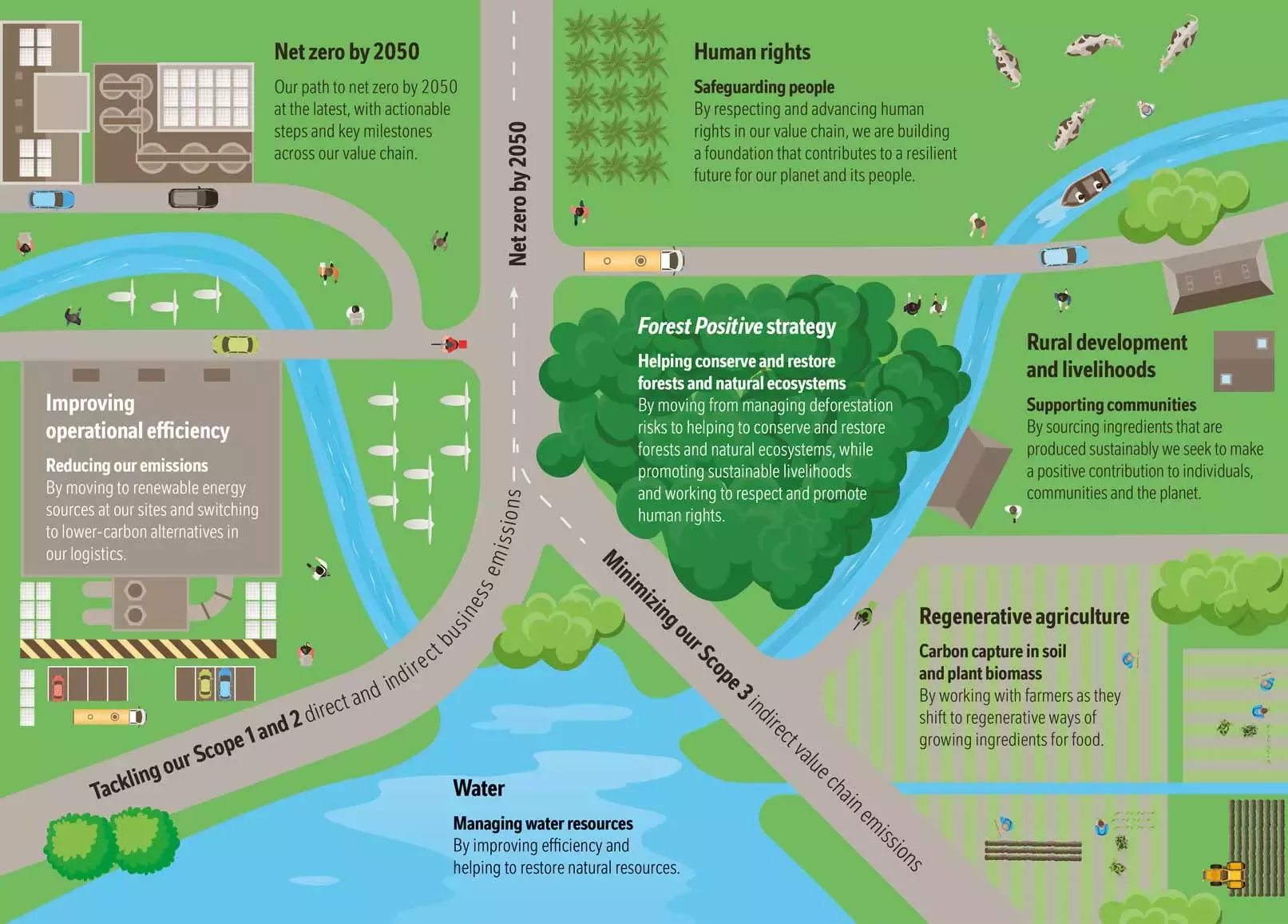
Download the full infographic (pdf, 6Mb)
Regenerative food systems are not aspirational, they are pragmatic. They benefit the entire supply chain, the whole of the company, and all of global society.

Downloads
Download our Annual Review, Non-Financial Statement & our Creating Shared Value at Nestlé publication.